
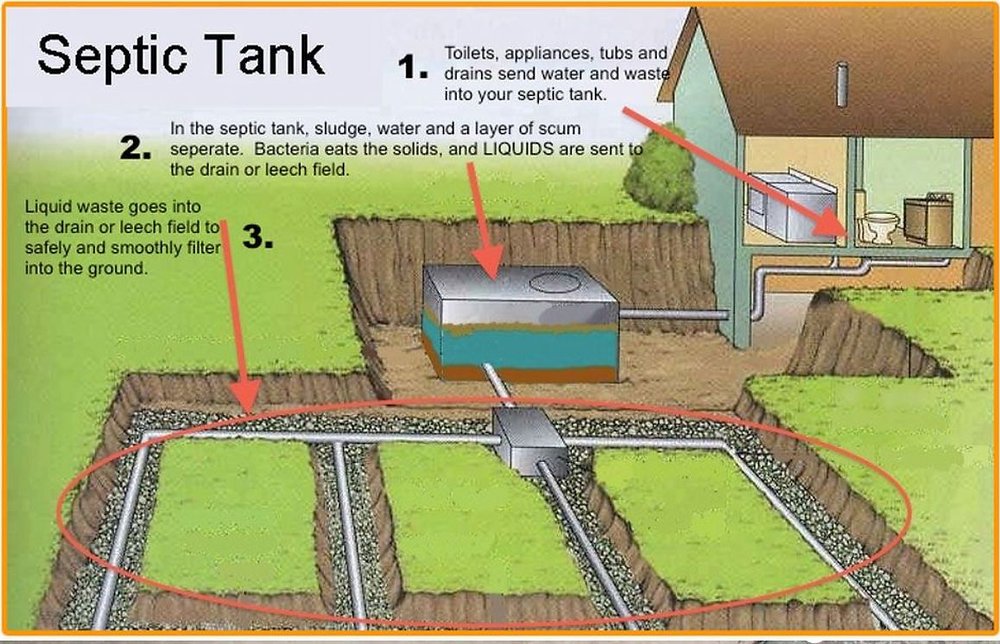
Septic system design involves sizing a tank based on bedroom count and engineering a drain field based on a soil percolation test. Key steps are: 1) Professional Soil Evaluation, 2) Tank Sizing (1,000 gal base + 250 gal/bedroom), 3) Drain Field Sizing (Design Flow / Soil Loading Rate), and 4) Layout respecting health code setbacks. A proper design prevents premature failure.
Design Fundamentals:
- Tank Size: Based on estimated daily wastewater flow (bedrooms).
- Drain Field Size: Determined by soil’s absorption rate (perc test).
- Layout: Must obey legal setbacks from wells, property lines, and water bodies.
Table of Contents
The Blueprint for a 30-Year Infrastructure Asset
A septic system is not installed; it is engineered. According to the Environmental Protection Agency (EPA), over 50% of system failures are linked to improper design or installation, turning a long-term asset into a recurring financial and environmental liability. This 2026 guide, developed with licensed septic system engineers, translates complex regulatory and hydrological principles into a clear planning framework. It empowers you to collaborate effectively with professionals to create a site-specific design that ensures compliance, longevity, and protects your property value from the ground up.
How Do You Size a Septic Tank and Drain Field?
You size a septic tank based on the home’s bedroom count (a proxy for daily flow) and size the drain field based on the soil’s percolation rate from a mandatory professional test. The tank holds solids; the drain field must be large enough for the liquid to absorb into the soil. Incorrect sizing of either is the leading cause of early system failure.
Bottom line: Tank size is calculated; drain field size is discovered through soil science. You cannot guess the drain field size.
How Far Does a Septic Tank Need to Be from the House?
Most state and local health codes require a minimum of 10 feet between the septic tank and the house foundation. This distance prevents potential structural issues and allows for maintenance access. Always verify the specific requirement with your local health department, as some jurisdictions may vary.
How to Design a Septic System: A 5-Step Professional Process
Follow this sequence to understand the professional design process from evaluation to permit-ready plans.
Step-by-Step Design Process:
- Conduct a Professional Site & Soil Evaluation (Non-Negotiable): A licensed soil evaluator performs deep soil pits and a percolation (“perc”) test to determine the soil type, depth to bedrock/water table, and the critical absorption rate (minutes per inch).
- Calculate Design Flow & Size the Tank: Using local code (typically 150 gallons/day/bedroom), calculate daily flow. Size the tank (e.g., 1,000 gallons for 1-2 bedrooms, +250 gal per additional bedroom).
- Calculate Required Drain Field Absorption Area: Use the soil’s loading rate (from the perc test) and design flow in the formula: Absorption Area (sq ft) = Daily Design Flow (gpd) / Soil Loading Rate (gpd/sq ft).
- Configure the Physical Layout: Translate the absorption area into a layout of trenches or a bed. Determine trench length, width, spacing (typically 6-10 ft apart), and orientation along the land contour.
- Finalize the Plan with Setbacks: Integrate the tank and field location onto a site plan, ensuring all components meet legal setbacks from wells (50-100 ft), property lines (10 ft), water bodies, and structures. A professional creates the final stamped drawing for permit submission.
Septic System Design Standards & Sizing Table (2026)
| Design Component | Standard Basis / Formula | Example (3-Bedroom Home) | Key Consideration |
|---|---|---|---|
| Daily Design Flow | Bedroom Count x Local Rate (e.g., 150 gpd/br) | 3 BR x 150 gpd = 450 gpd | Local codes vary; always use your jurisdiction’s rate. |
| Septic Tank Size | Base (1,000 gal) + 250 gal per additional BR. | 1,000 gal + (1 x 250 gal) = 1,250 gallons | Undersizing causes pump-outs & failure; oversizing is wasteful. |
| Soil Loading Rate | From Perc Test (e.g., 60 min/inch = 0.2 gpd/sq ft). | 0.2 gallons/day/square foot | The slower the soil, the larger the field required. |
| Drain Field Area | Design Flow / Loading Rate. | 450 gpd / 0.2 gpd/sq ft = 2,250 sq ft | This is the absorption area, not just land footprint. |
| Typical Trench Layout | Trenches 24-36″ deep, 18-36″ wide. Spaced 6-10′ apart. | For 2,250 sq ft @ 2.5 ft wide: 900 linear ft of trench. | Trenches provide more sidewall absorption area than a single bed. |
Expert Q&A: Solving Common Septic Design Challenges
Q: How big of a drain field do I need for a 3-bedroom house?
A: There is no standard size. For a 3-bedroom home (450 gpd), the required area can range from 1,500 to over 4,000 square feet based solely on soil type. A fast-draining sandy soil needs less area; a slow-draining clay soil requires a much larger field or an engineered alternative.
Q: Can you put a septic system in clay soil?
A: Yes, but it requires careful engineering. Pure clay often fails perc tests. Solutions include: 1) A mound system built above ground, 2) An Aerobic Treatment Unit (ATU) that pre-treats wastewater for a smaller field, or 3) A very large, shallow conventional field if a suitable layer exists. A professional evaluation is critical.
Q: What is the best septic system for a small lot?
A: For small lots with suitable soil, a chamber system or drip dispersal field can be more compact. For small lots with poor soil, an Aerobic Treatment Unit (ATU) with a drip irrigation field is often the only viable solution, as it requires the smallest absorption area and can be installed in challenging landscapes.
Q: How deep should a septic drain field be?
A: Drain field trenches are typically 18 to 36 inches deep. The exact depth is mandated by code to place the infiltrative surface within suitable, unsaturated soil—above the seasonal high-water table and any restrictive layer like bedrock or clay.
Q: How do I find the “as-built” design for my existing system?
A: Contact your local county health department’s environmental health division. They maintain records of all permitted system installations, including the original design (“as-built”) diagram. This is essential for repairs, expansions, or property sale.
Q: What are the most common setbacks required?
A: Typical minimum setbacks include: 50-100 feet from wells, 10 feet from property lines, 10 feet from building foundations, 50-100 feet from streams/lakes, and 5-10 feet from driveways. Your local code is definitive.
The 3 Critical Reports for a Successful Design
You cannot design a system without these 3 professional reports:
- Site & Soil Evaluation Report: Includes soil logs, percolation rate, and depth to limiting conditions.
- Property Survey: Shows exact boundaries, topography, and locations of wells, structures, and water bodies.
- Local Health Department Regulations: The official rulebook specifying design flows, loading rates, tank sizes, and setbacks for your jurisdiction.
Red Flags in a Septic System Design Plan
Engineers warn these design flaws lead to a 90% probability of failure within 10 years:
- No recent, property-specific soil test (using a neighbor’s test or an old report).
- Setback violations or a plan that places the field in a low-lying, drainable area.
- Incorrect loading rate application for the soil type.
- Missing a designated reserve area for future drain field replacement.
- Plans that don’t account for future home expansion (adding bedrooms).
Engineering Certainty into an Uncertain Environment
While the principles of septic design are universal, their application is hyper-local. The synthesis of expert insight is clear: the quality of your soil report dictates the success of your entire design. Investing in a thorough, professional site evaluation is the single most cost-effective step in the process, preventing the catastrophic expense of retrofitting a failing system. Your role as a homeowner is not to be the designer, but the informed project manager—ensuring your hired professionals follow this rigorous, data-driven process. By championing a design based on soil science and code compliance, you secure a system that functions as a silent, reliable asset for decades.
Begin with the critical first step. Contact a licensed soil evaluator in your area to schedule a site and soil evaluation. This report is the non-negotiable foundation for all subsequent design and budgeting.

Leave a Reply